
Performance Trends, Inc.
Producing Quality Computer Tools for Racers and Engine Builders since 1986
Re: Performance Trends Newsletter (updates)
To: Visitors to Performance Trends Website
Subject: Product News/Updates, September 2026
Re: Performance Trends Newsletter (updates)
To: Visitors to Performance Trends Website
Subject: Product News/Updates, September 2026
 to
visit our www.performancetrends.com
home page
to
visit our  facebook page and "like" us.
for our full  You Tube channel
-------------------------------------------
1) 3 Compression Ratio Calculators - Featured Product If you are most any type of engine builder, our Compression Ratio Calculator is a great addition to your toolbox. It calculates compression ratio with as few inputs as possible, or by taking most all details into account, and something in between. It also calculates and checks other critical engine specs like deck height "stack up" for piston compression height, rod length, etc. Then it has more advanced Plus and Pro versions with even more features.
The Compression Ratio Calculator will make sure you don't make simple math
errors, saves your data for access in the future, and provide a professional printout for your customers. The Plus
and Pro version lets you include your company logo (a jpg file) on your
printouts. And it can link up to our Engine
Build Log Book, Engine
Build Log Book Pro or our Engine
Analyzer Pro Enterprise Edition software for organizing the compression
ratio inputs for either of these three programs.
for info on how the Engine Analyzer Pro "talks" to the
Compression Ratio Calculator, Figures A77 through A80, pages 295-298.

The program can also answer more complicated questions like:
These and thousands more questions can be answered by the Compression Ratio Calculator.
PRO Version's Calculated Piston Dome CCs from Geometry, just one of many
piston volume calculation screens
 (click image to enlarge)
for more info on our Compression Ratio Calculator
For youtube videos
-------------------------------------------
2) New FAQs We are constantly adding more answers to our Frequently Asked Questions (FAQ) page, to help users better understand and use our products. If you have never visited that page, you really should. It goes into details we can't do in the User Manuals or youtube videos. Here's two recent FAQs we've added:
for Engine Analyzers: "How accurate do I need to be with the
inputs to my Engine Analyzer to get the most accurate power curves?"
Click on the graph below to see how peak cylinder pressure varies in a real running race engine from firing to firing. If everything was simple and precise like calculating compression ratio, each peak cylinder pressure would be exactly up to the red dotted line, not above it or below it. But you can see it is all over the place. It is chaos which is what is happening in the actual engine.
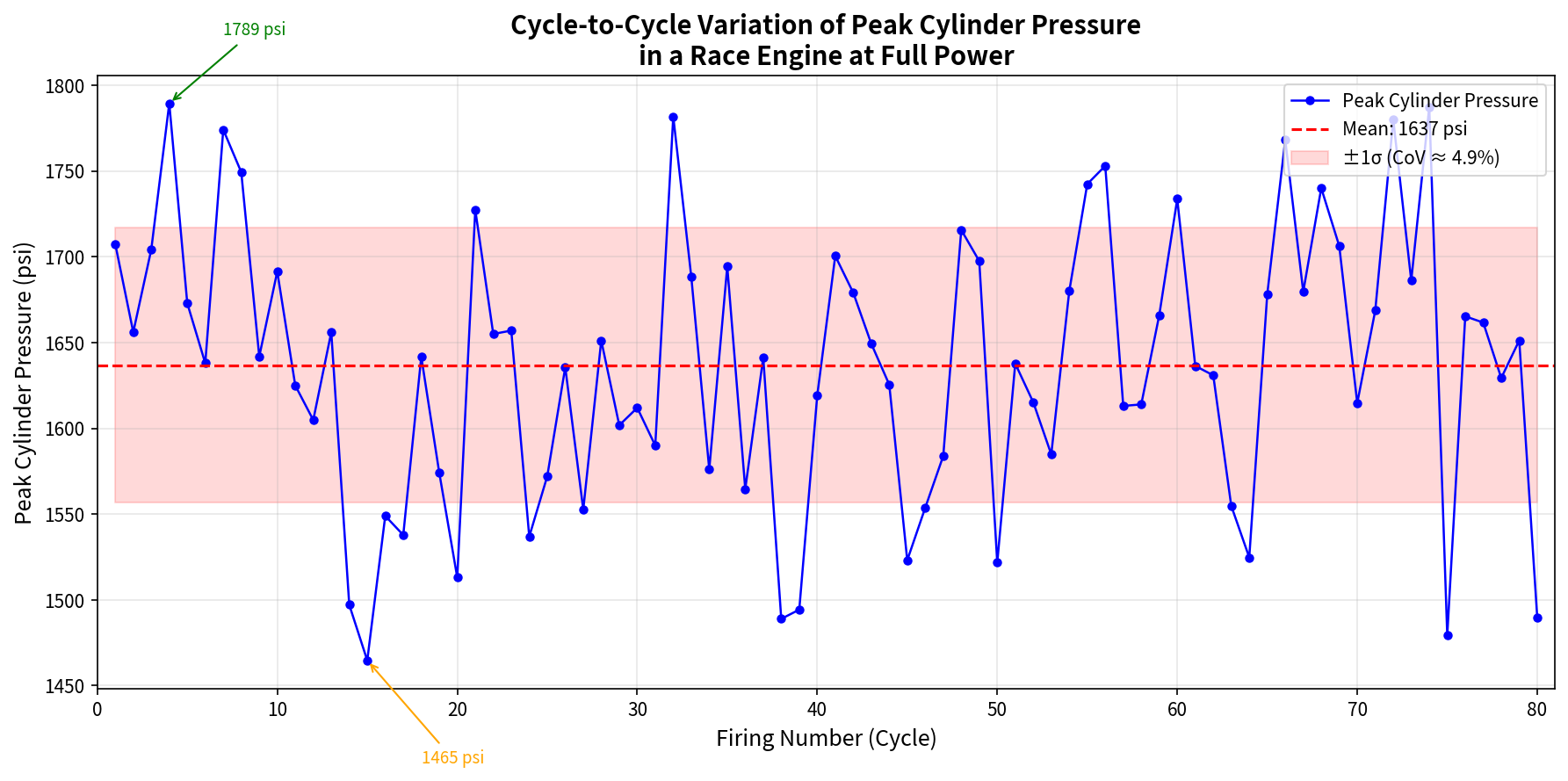 (click this image generated by Grok AI to enlarge it)
for Engine Analyzers: "Does the Engine Analyzer or Engine
Analyzer Pro consider Port Size (volume) when estimating Performance?"
for Valve Spring Testers: "After testing my valve springs,
can the software tell me the required install height (or amount of shim) to
produce a certain seated force?"
Starting in v1.1B Plus, there is a special report option called Shimming Report to do shimming recommendations automatically. Check out the picture below from the Valve Spring Tester User Manual.
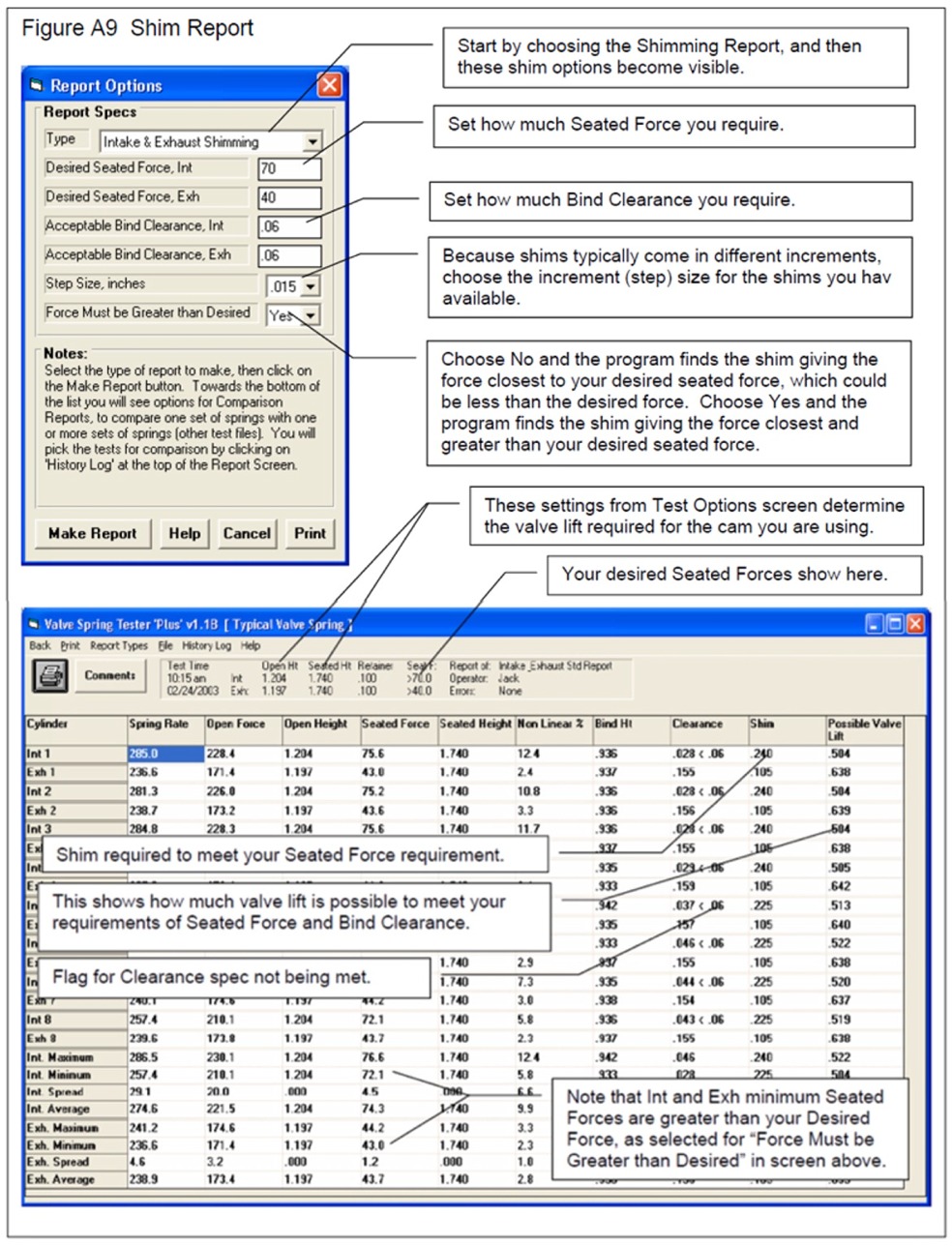 (click image to enlarge it)
for DataMite Data Loggers: "How can I make my flow meter read
Gallons per Minute for water?"
for our entire Frequently Asked Questions page to see answers to
hundreds of questions about all our products
-------------------------------------------
3) Last August's Newsletter Here are the topics covered in our previous newsletter. If you would like another copy of August 2026's newsletter (or any previous newsletter) for detail on these topics, visit our website at: Performance Trends Newsletters
Performance Trends reserves the right to discontinue, update, or modify its product line and pricing at any time.